

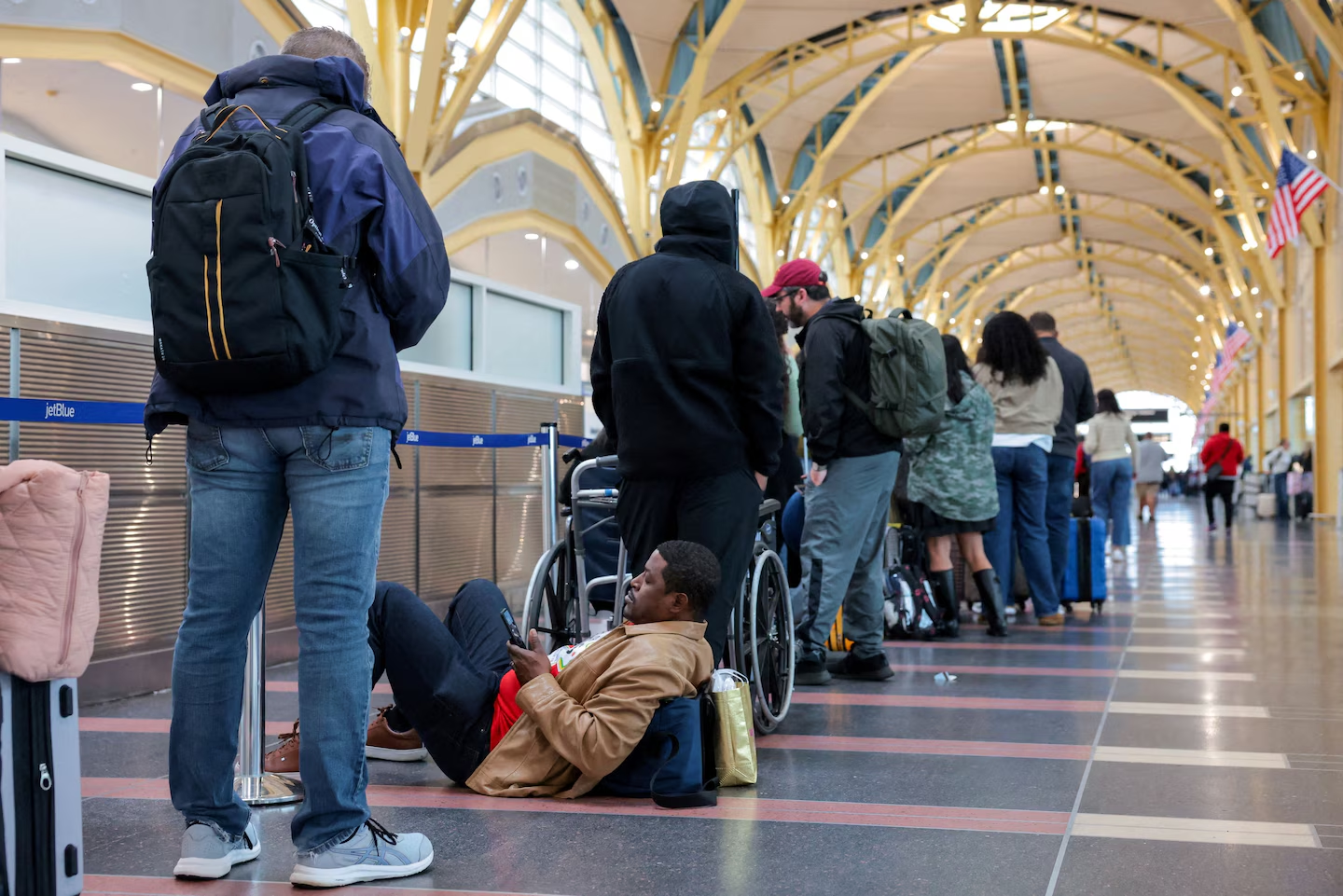
Watching your departure time tick closer while you are trapped fifty people deep in an airport security queue is a specific brand of travel misery. You did what felt reasonable: you left home on time, navigated traffic, and walked into the terminal with an hour and a half to spare. Yet a sudden staffing crunch, a broken x-ray lane, or an unexpected holiday surge turned the standard security line into a crawling bottleneck. By the time you finally step through the metal detector, gather your shoes, and sprint toward your concourse, the gate door is shut and the jet bridge has retracted.
Panic and anger are natural first reactions, but letting them dictate your next move will cost you time and money. While airlines and the Transportation Security Administration operate as separate entities with zero legal obligation to coordinate on your behalf, you are far from helpless. Understanding how airline policies function behind the scenes gives you the leverage to salvage your trip without paying exorbitant walk-up airfare.
Understand the Blame Game: Airline Policy vs. Checkpoint Reality
The first hurdle travelers encounter is bureaucratic detachment. When you tell an airline representative that an hour-long security queue caused you to miss your departure, their standard contractual response is simple: airport arrival timing is your responsibility.
Every domestic carrier lays out specific check-in and boarding gate cutoff times in its Conditions of Carriage. For most major US carriers, you must be present at the boarding gate ten to fifteen minutes prior to departure for domestic routes, and thirty to sixty minutes for international flights. Legally, the airline does not care whether you were delayed by highway construction, a long coffee line, or a backed-up checkpoint. TSA is a federal agency under the Department of Homeland Security, not an airline employee group, meaning the airline views security delays as external factors outside their operational control.
TSA maintains a similar hands-off stance toward individual schedules. Checkpoint officers focus entirely on passenger screening; they do not monitor flight manifests or flight status boards. Complaining to checkpoint personnel once the plane is gone will produce nothing more than a blank stare or a customer service website card.
Accepting this division of responsibility immediately is critical. The key to getting rebooked at little or no cost lies not in assigning blame to the federal government, but in leveraging established, discretionary airline customer service policies.
What to Do While You Are Still Trapped in the Line
If your departure time is minutes away and you are clearly not going to clear the metal detector in time, shift into active problem mitigation before you ever step through the magnetometer.
First, notify a checkpoint agent or supervisor calmly. While officers scanning boarding passes generally will not pull travelers out of standard lanes simply because they ran late, many airports have an on-duty supervisor near the document verification station who can exercise discretion. Show your active boarding pass, point out that boarding ends in five minutes, and politely ask if expedited screening through an open lane is possible. Some airports actively manage “imminent departure” passengers; others strictly refuse. It never hurts to ask, provided your tone remains composed.
Second, pull out your smartphone and contact the carrier before the flight departs. If you wait until after departure, your itinerary might be automatically canceled as a “no-show,” which can wipe out downstream legs, including your return ticket. Use the carrier’s mobile chat feature, call their reservation line, or direct-message their customer support team on social media. Letting them know you are held up at the security checkpoint allows agents to note your reservation and, in some instances, protect your seat on a subsequent flight before the system purges your profile.
Head Straight to the Customer Service Desk or Gate
Once you clear security, walk briskly to your departure gate if there is any possibility the flight took a ground delay. Weather and air traffic control frequently hold planes on the tarmac or at the gate longer than published departure times indicate.
If the aircraft has pushed back, locate the nearest customer service representative or your carrier’s customer assistance center immediately. How you frame the situation in these first sixty seconds dictates whether you walk away with a free standby seat or a four-hundred-dollar change fee.
The Power of the “Flat Tire Rule”
Most legacy and major US airlines—including Delta, United, American, Southwest, and Alaska—maintain an unwritten or internal policy informally dubbed the flat tire rule.
This guideline allows customer service representatives to accommodate passengers who missed their flight due to unforeseen events beyond their immediate control, provided they show up at the airport within a reasonable window, typically within two hours of their missed departure time.
When invoked properly, the agent can place you on standby for the next available flight to your destination, or even confirm a seat on a later departure, without charging a same-day change penalty or collecting the difference in airfare.
To make this work in your favor:
-
Do not approach the counter aggressively or demand free compensation for an airline error. Checkpoint queues are not carrier faults, and front-line agents respond poorly to entitlement.
-
State the facts clearly: explain the checkpoint delay, confirm that you arrived at the airport within standard recommended windows, and ask if they can apply same-day standby or emergency accommodation under their late-arrival guidelines.
-
Keep your boarding pass handy so they can verify your original flight details and the timestamp of your arrival at their desk.
What Happens to Your Checked Luggage?
One of the most disorienting aspects of missing a flight is realizing your checked baggage may have embarked on the journey without you.
On domestic US flights, airlines are not legally required to remove checked baggage from an aircraft if the ticketed passenger fails to board, a concept distinct from international travel where strict Positive Passenger Bag Match (PPBM) regulations generally require unloading unaccompanied bags. Consequently, domestic bags often travel to the scheduled destination on time.
As soon as you finish speaking with the gate or rebooking agent, check your airline app’s luggage tracker. Most major carriers provide real-time scans as bags are loaded onto the plane, transferred at hubs, and unloaded at baggage carousels.
If your bag flew ahead of you, find the airline’s baggage service office at your current airport to ensure they flag your claim check. When you eventually land at your destination, your luggage will typically be pulled from the public carousel and held securely in the local baggage service office until you arrive to present your claim tag and identification. If the bag was held back or rerouted due to weight constraints, the baggage office can coordinate linking its routing to your new boarding pass.
Explore Alternate Routes and Co-Terminal Airports
When security backups occur, flights departing in the subsequent hours are often already operating near capacity. If the agent informs you that standby lists for your original route are fifty passengers deep, expand your geographic flexibility.
Ask the representative about flights departing to alternative airports near your destination, often referred to as co-terminals.
-
Flying to the New York area? If LaGuardia is completely booked, request to be placed on flights routing into Newark or JFK.
-
Traveling to Washington, DC? Look at options across Reagan National, Dulles, and Baltimore-Washington International.
-
Bound for Southern California? Consider flights into Burbank, Santa Ana, or Long Beach instead of waiting twelve hours for an open seat into Los Angeles International.
Similarly, if your original flight was a nonstop, ask whether connecting through an airline hub can get you to your destination faster than waiting for the next direct service the following morning. Taking a two-hour layover in Charlotte, Chicago, or Denver often beats sitting on an airport carpet overnight.
Check Your Credit Card Travel Protections
Because the airline did not cause your delay, do not expect them to issue hotel vouchers, meal credits, or ground transportation passes. However, if you purchased your ticket using a premium travel rewards credit card, you may possess built-in insurance coverage that cushions the financial hit.
Many premium credit cards offer comprehensive travel delay reimbursement. Review your card’s benefits guide to check whether missed connections due to unexpected transportation and processing delays qualify under their trip disruption policies. If an overnight stay becomes unavoidable and you fall under covered conditions, your card issuer may reimburse documented hotel stays, meals, and essential sundries up to specified policy limits. Keep digital receipts for every expense incurred from the moment your flight departs until you reboard.
File an Incident Report with TSA
While reporting the delay to the Transportation Security Administration will not bring your airplane back, documenting excessive checkpoint delays creates accountability and establishes an official paper trail if you seek financial restitution from travel insurance.
TSA provides a dedicated online submission form through their customer service portal. When submitting a complaint, include:
-
The exact airport, terminal, and checkpoint number you entered.
-
The time you entered the queue versus the time you cleared the scanner.
-
Photos or screenshots of posted wait-time boards, your boarding pass, or airport wait-time tracking apps.
-
A clear description of operational bottlenecks, such as unattended lanes during peak rush hours or equipment failures.
Submitting this data helps federal oversight boards assess airport staffing models and provides you with an incident case number, which can be useful documentation for insurance underwriters or corporate travel administrators reconciling unexpected expenses.
How to Prevent Checkpoint Bottlenecks in the Future
Experiencing a missed flight due to security lines changes how you approach the terminal going forward. Incorporating a few simple operational tools eliminates the volatility of standard general screening lines entirely.
First, invest in trusted traveler programs. Enrolling in TSA PreCheck grants access to dedicated lanes where passengers keep shoes, belts, and light jackets on, and laptops remain in bags. These lines move substantially faster and rarely suffer the severe bottlenecks seen in standard security. Pair it with programs like CLEAR, which uses biometric identity verification to bypass the primary document verification line at dozens of domestic airports.
Second, leverage modern airport appointment technologies. A growing number of major US hubs—including Seattle, Orlando, Phoenix, Los Angeles, and Newark—now offer free, reservation-based checkpoint programs commonly called Virtual Line or Spot Saver. These systems allow travelers to book a designated fifteen-minute window to enter a dedicated screening lane up to three days before their flight, completely free of charge.
Finally, calibrate your arrival time to the airport’s operational realities rather than theoretical minimums. Early morning departure windows between 5:00 AM and 8:00 AM regularly overwhelm security checkpoints as business travel and tourist flights depart simultaneously. Arriving two full hours prior to domestic boarding during peak travel holidays or morning rush hours provides the necessary buffer to navigate unexpected terminal chaos without your heart rate spiking.
